11L and 18L Delivery Beats Hauling Jugs for CPAP Travel Water
Distilled water is still the right call for your CPAP humidifier away from home, and travelling with it is straightforward once you know the rules. Empty the humidifier chamber before airport security, pack a small labelled bottle for your carry-on liquids bag, and plan to buy larger bottles once you land. If distilled water isn’t available right away, purified bottled water or an HME filter will get you through a night or two safely.
TL;DR:
- Travelers should drain and dry their CPAP humidifier chamber the night before flying to prevent leaks, mildew, or delays during security screening.
- Carrying small, labeled distilled water bottles in carry-on liquids is permitted, but larger bottles must be packed in checked luggage or bought after landing to avoid security issues.
- Once at the destination, distilled water is readily available at pharmacies, grocery stores, or hotel services, but shop carefully to avoid mineral-rich options that can harm the humidifier.
- For longer stays, arranging scheduled local delivery of distilled water can be a convenient alternative to hauling jugs, especially in remote or unfamiliar areas.
- In case distilled water is unavailable, short-term substitutes like purified bottled water, HME filters, or short durations without humidification can keep CPAP functioning safely.
CapitalflowSimplify Your Distilled Water SupplyCapitalflow delivers distilled water throughout Ottawa and the National Capital Region, with flexible schedules and no long-term contracts.Visit Capitalflow
Table of Contents
- Your pre-travel checklist for CPAP travel water
- What happens at airport security with a CPAP machine?
- Where can you buy distilled water once you land?
- What if you can’t find distilled water at all?
- How do you stop rainout in a hotel room?
- How should you clean and pack CPAP gear on the road?
- What CPAP travellers get wrong most often
- What actually matters when you travel with a CPAP
- Longer stays deserve an easier water solution
- Where this guide’s advice comes from
- Sources
- FAQ
Your pre-travel checklist for CPAP travel water
Getting through security and settling into a hotel room without a hitch comes down to what you pack the night before, not what you scramble for at the gate. Run through this list before you close your suitcase.
- Drain and dry the humidifier chamber the night before. A damp tank in a packed bag is how leaks and mildew smells happen, and it’s one habit that solves both problems at once.
- Pack the CPAP machine itself in your carry-on, not checked luggage. Airlines treat it as a medical device, and checked bags get lost more often than overhead bins.
- Put a labelled travel-size distilled bottle in your liquids bag in the amount allowed by carry-on liquid restrictions. Anything larger goes in checked luggage or gets bought after you clear security.
- Bring a copy of your prescription or device documentation. Security staff rarely ask, but when they do, having it ready saves you a conversation you don’t want to have at 5:00 a.m.
- Pack an HME filter or plan to skip humidification for short trips. It’s a lightweight backup that weighs almost nothing in your bag.
- Bring the right power adapter or spare batteries if you’re heading abroad. A CPAP that won’t power on is a bigger problem than a dry tank.
Pro Tip: Set a phone reminder for “drain CPAP tank” the night before every trip. It takes 30 seconds and prevents the single most common travel mistake CPAP users make.
What happens at airport security with a CPAP machine?
Security officers are used to seeing CPAP machines, and in Canada, the Canadian Air Transport Security Authority treats CPAP devices as medical equipment that travel separately from your regular carry-on allowance. That means your machine, tubing, and mask usually don’t count against your one-bag limit, but they still need to go through the X-ray scanner.
A few things make the screening process faster:
- Empty the humidifier tank before you reach the checkpoint. A tank with water in it can trigger a manual inspection, and nobody wants to be that person holding up the line.
- Keep the machine easily accessible in your bag. Officers may want to swab it or run it through the scanner separately.
- Declare medically necessary liquids. Small volumes of distilled water carried for CPAP use are generally permitted through screening when declared, though they may draw extra scrutiny.
- Check your airline and destination country’s rules ahead of time. Policies differ enough between carriers and jurisdictions that a five-minute check beats a surprise at the gate.
Here’s the number that matters most for planning: CATSA’s own guidance confirms CPAP devices are exempt from standard carry-on limits, but it does not exempt the water inside the tank from liquid restrictions. That distinction trips up a lot of first-time travellers who assume the whole kit gets a free pass.
If you’re carrying anything beyond a small travel bottle, put it in checked luggage or plan to buy it after you land. Sleepapnea recommends this exact approach: travel light through security, restock once you’re through.
Where can you buy distilled water once you land?
Finding distilled water at your destination is usually easier than people expect, but it helps to know exactly what to look for on the shelf.
- Pharmacies and drugstores almost always stock distilled water near the first-aid or baby-care section, even in smaller towns.
- Grocery stores and big-box retailers carry it in the water aisle, typically a few dollars for a gallon-sized jug.
- Hotel guest services can sometimes point you to the nearest source or, at higher-end properties, provide a bottle on request.
- Cruise ship guest services are worth contacting before you sail. Many lines will supply distilled water for CPAP use if you ask ahead of time rather than at the front desk on embarkation day.
Read the label carefully. You’re looking for plain steam-distilled water with no additives, not “purified,” “spring,” “alkaline,” or electrolyte-enhanced water. Those products can carry mineral content that leads to scaling inside your humidifier chamber, and manufacturers specifically recommend distilled water because it’s free of the minerals that cause buildup and support bacterial growth.
For a short stay, a single small jug is plenty. For longer stays, some travellers find it more practical to arrange local delivery rather than hauling jugs from store to store every few days, particularly if they’re staying somewhere without easy walking access to a pharmacy or grocery store. Retailers like Pure Wave Water also carry distilled and purified water products if you’d rather buy in advance than search once you arrive.
What if you can’t find distilled water at all?
Sometimes distilled water just isn’t available, whether you’re in a rural area, a country where it’s sold under an unfamiliar label, or simply stuck without a car. A few workarounds get you through without damaging your equipment, though each comes with a trade-off.
- Purified or filtered bottled water works for a night or two. Clinical guidance from Sleep Foundation notes it’s an acceptable short-term substitute, but it will leave mineral deposits faster, so plan to clean the tank more often than usual.
- An HME (heat and moisture exchanger) filter replaces water-based humidification entirely. It’s not as effective in very dry climates, but it eliminates the water problem altogether for a short trip.
- Running the machine without humidification for a couple of nights is tolerable for many people, especially in humid climates where dry air isn’t much of an issue anyway.
- Portable water distillers exist, but they’re slow, bulky, and rarely worth packing for anything shorter than an extended stay.
Pro Tip: If you switch to bottled water mid-trip, rinse the humidifier chamber with it daily instead of waiting until you get home. Mineral scale builds up faster than you’d think, sometimes visible within three or four uses.
How do you stop rainout in a hotel room?
Rainout, that unpleasant gurgle of condensation building up in your tubing, happens when there’s a temperature gap between the humidified air in your hose and the cooler air around it. Hotel rooms are notorious for this because air conditioning runs colder and drier than most people’s bedrooms at home, which widens that gap and pushes condensation right into your mask.
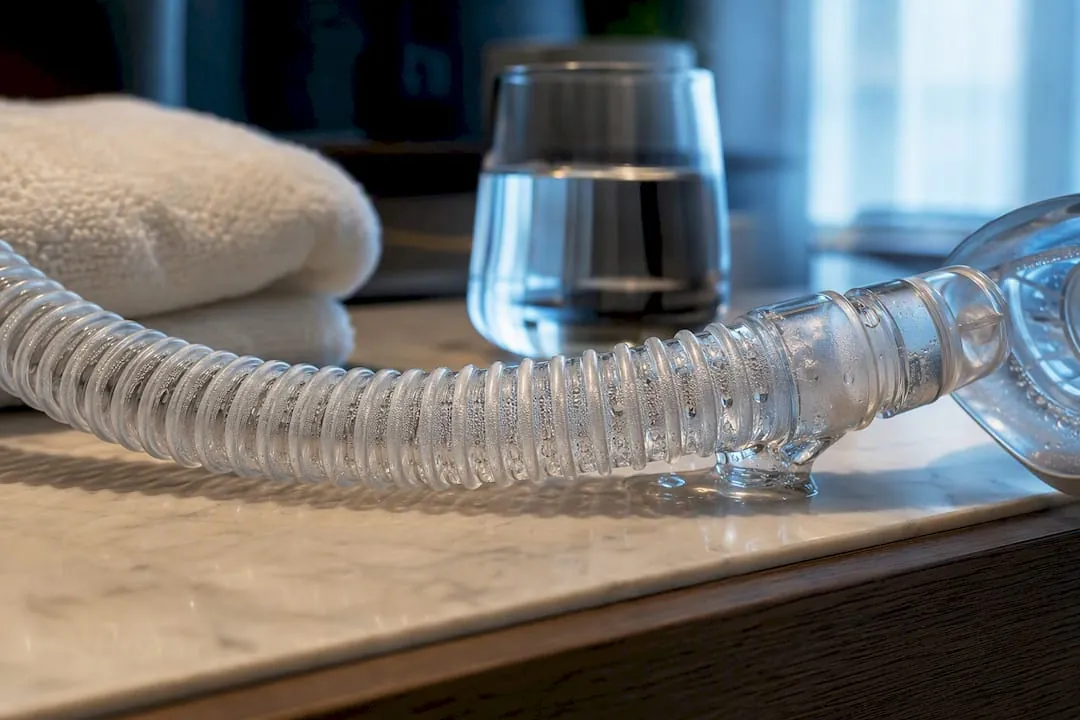
The fix usually starts with your humidity setting, not your water source. ResMed’s own travel guidance points out that humidification behaviour changes across climates, and a setting that felt perfect at home can flood your tubing somewhere hotter or more humid, or dry out your throat somewhere colder.
A few adjustments help you find a new baseline fast:
- Lower your humidity setting by one or two levels on your first night and adjust from there once you see how your body reacts.
- Shorten your tubing if possible, or route it under the blanket rather than letting it dangle across cold hotel air.
- Keep the machine at or below mattress level. Gravity pulls condensation back into the humidifier chamber instead of your mask.
- Wipe down the tubing promptly if you notice moisture pooling. Letting it sit invites both discomfort and bacterial growth.
If none of that solves it, turning off humidification for a night or two is a reasonable temporary fix. Just remember to dial it back up gradually once you’re home and back in familiar air.
How should you clean and pack CPAP gear on the road?
Travel throws off your normal cleaning routine, but a few consistent habits keep your equipment sanitary without turning your hotel bathroom into a lab.
- Empty and fully dry the humidifier chamber the night before you leave. Store it in a sealed bag separate from your other gear so any residual moisture doesn’t spread.
- Do a quick daily clean while you’re away. Mild soap and water on the mask and tubing, air-dried overnight, keeps buildup manageable. Mask wipes work well for a faster once-over between full cleans.
- If you absolutely must pack a chamber that’s still slightly wet, double-bag it and wrap it in a towel inside a hard case. This isn’t ideal, and it’s worth avoiding in checked luggage entirely, where pressure changes and rough handling make leaks more likely.
- Pack spare filters, a backup mask cushion, and a printed copy of your prescription. These take up almost no space and solve problems you can’t fix on the fly.
Respiratory device hygiene matters more when your equipment is exposed to unfamiliar tap water, hotel humidity, or a rushed cleaning schedule, and clinical guidance on respiratory device contamination risk backs up why the extra five minutes of daily cleaning is worth it on the road.
What CPAP travellers get wrong most often
The three mistakes I see repeated constantly are almost always avoidable: travellers forget to empty the tank before the airport, they toss a water bottle into their bag without labelling it as medically necessary, and they never check their airline’s specific policy before departure day. Each one is a five-minute fix the night before, not a complicated logistics problem.
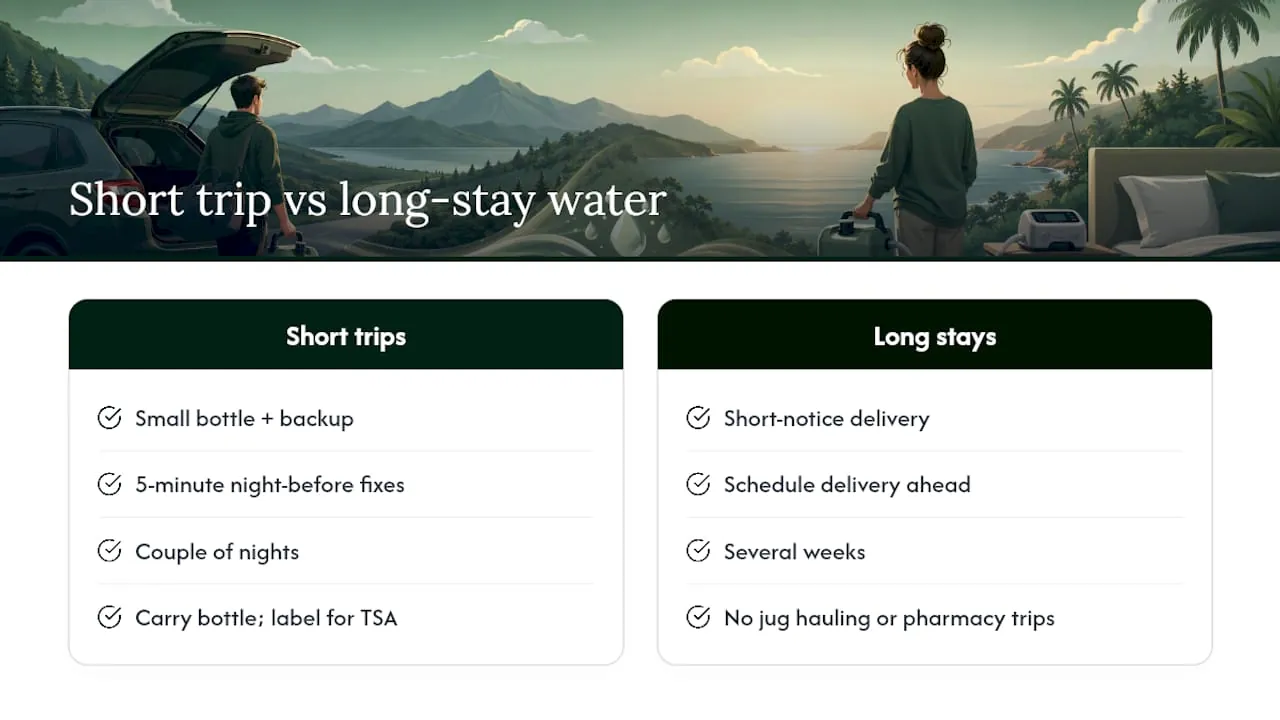
What’s often overlooked is how travel itself changes water needs. A weekend trip and a three-week stay call for completely different approaches. For a couple of nights, a small bottle and a backup plan cover you fine. For longer stays, especially when you’re bunking with friends or family who don’t have a spare gallon of distilled water sitting in the pantry, scheduled short-notice delivery removes the guesswork entirely. You’re not hauling jugs through an airport or hunting down a pharmacy in an unfamiliar neighbourhood. You just have water arrive when you need it.
What actually matters when you travel with a CPAP
The conventional advice on CPAP travel tends to fixate on airport security, and fair enough, that’s the part that intimidates first-timers most. But security screening is the easy part once you know the rule: empty the tank, declare the liquid, keep documentation handy. The part that actually causes problems on a trip is what happens after you land.
Most CPAP users default to buying a jug of distilled water at the first pharmacy they find, and that works fine for a weekend. It stops working once you’re three days into a two-week stay and realize you’re now cleaning your tank with tap water because you ran out and didn’t want to make another trip to the store. That’s where scaling and bacterial growth actually start, not at the airport.
If there’s one thing worth prioritizing, it’s planning your water source for the entire length of your stay before you leave home, not just for the flight. A five-minute search for pharmacies near your destination, or a quick call to your hotel, solves more problems than any amount of airport prep.
— Yan
Longer stays deserve an easier water solution
A practical alternative to hauling distilled water jugs through an airport or scrambling between pharmacies on a multi-day trip is to arrange scheduled delivery of distilled water locally. If you’re staying in the Ottawa or National Capital Region area for a week, a month, or longer, scheduled delivery means your CPAP water shows up on your timeline instead of the other way around.

Distilled water is commonly available in 18L and 11L bottle sizes, with delivery options that may include one-time, weekly, biweekly, or monthly schedules. Some suppliers offer no long-term contract for residential customers, transparent pricing with no hidden fees, and refundable bottle deposits. This setup works best for long-stay travellers, people visiting the region frequently, or anyone staying with friends or family who don’t already have a distilled water supply on hand.
If your next trip has you settling in for more than a few nights, check delivery availability and book your first order with Capitalflow before you pack.
Where this guide’s advice comes from
The recommendations above lean on airport security guidance, sleep-health clinical resources, and manufacturer documentation rather than guesswork.
- CATSA’s official CPAP device guidance for what to expect at Canadian airport security checkpoints.
- Sleepapnea and travel-specific advice on packing and destination sourcing.
- ResMed’s AirMini travel CPAP guidance on adjusting humidity settings across climates.
This article is general information, not a substitute for advice from a qualified doctor. Consult a qualified healthcare professional about your own circumstances before acting on anything here.
Sources
FAQ
What is the 4-hour rule for CPAP?
The 4-hour rule refers to insurance and clinical compliance standards requiring CPAP use for at least four hours per night on 70% of nights to qualify as adherent. It’s not a travel restriction, but it’s worth keeping in mind when deciding whether to skip humidification or use your device on a short overnight flight.
Where can I buy distilled water while travelling?
Pharmacies, grocery stores, and big-box retailers almost always stock distilled water in the same aisle as bottled water. Hotel guest services or cruise ship staff can also point you to a source, and some cruise lines will supply it if you ask before you sail.
What can I use for my CPAP if I don’t have distilled water?
Purified or filtered bottled water works for a night or two, though it requires more frequent tank cleaning to avoid mineral scaling. An HME filter or running the machine without humidification for a short trip are also safe short-term options.
Can I take distilled water on a plane?
Yes, small volumes of distilled water for CPAP use are generally permitted in carry-on luggage when declared as a medically necessary liquid. Larger bottles should go in checked luggage or be purchased after you clear security.