18.2 MΩ·cm Gap: Distilled or Deionized Water for Home Use
Distilled water is made by boiling water into steam and re-condensing it back into liquid; deionized water is made by pushing water through ion exchange resin that strips out charged particles. The two aren’t interchangeable for every job: distilled water is generally fine for appliances and occasional drinking, while deionized (DI) water isn’t recommended as drinking water and belongs in ion-sensitive technical work instead. Always check your device or lab protocol before swapping one for the other.
TL;DR:
- Deionized water can reach resistivity levels up to 18.2 MΩ·cm, making it suitable for lab-grade purification, whereas distilled water typically only measures 0.5 to 1 MΩ·cm.
- Distillation effectively removes microbes, particulates, and most dissolved solids, but may not eliminate volatile organic compounds without additional filtration.
- Deionization excels at removing ions and salts but does not eliminate uncharged organics, bacteria, or viruses, requiring pairing with filters or UV treatment for microbial control.
- For household or medical appliances like CPAP machines and steam irons, distilled water is preferable to prevent scale build-up and microbial contamination, especially in breathing devices.
- Making distilled water at home is possible but yields low volume and may not remove VOCs, so regular delivery is recommended for consistent use.
CapitalflowKeep Distilled Water On HandPurity in Motion delivers distilled water throughout Ottawa and the National Capital Region on a schedule that suits your needs.Visit Purity in Motion
Table of Contents
- Distilled vs deionized water: how each one is actually made
- Purity metrics: what TDS and resistivity actually tell you
- What each method misses, and where that gap matters
- Common uses and which water actually belongs there
- Is it safe to drink? Distilled and deionized water compared
- Can you substitute one for the other? A quick checklist
- Can you make distilled water at home?
- Our take: skip the DIY math if convenience matters more
- Get distilled water delivered instead of making it yourself
- Sources
- FAQ
Distilled vs deionized water: how each one is actually made
Distillation and deionization solve the same problem, purity, with completely different tools. One uses heat, the other uses chemistry.
Distillation works like this:
- Water is heated to boiling point in a chamber.
- The steam rises, leaving behind minerals, salts, and most microbes.
- The steam travels through a condenser and cools back into liquid.
- The condensate is collected as distilled water.
Home units run single-pass. Industrial and pharmaceutical operations often use multi-effect stills that reuse heat across several stages, which improves energy efficiency but adds equipment cost.
Deionization skips heat entirely. Water passes through cation resin (which swaps out positively charged ions like calcium and sodium) and anion resin (which removes negatively charged ions like chloride and sulphate). Most systems combine both in a mixed-bed configuration for a single pass. DI units usually need upstream pretreatment, activated carbon or reverse osmosis, because raw tap water would exhaust the resin too fast. Many labs pair reverse osmosis with deionization specifically to hit higher purity targets than either method achieves alone.
Purity metrics: what TDS and resistivity actually tell you
The gap between distilled and deionized water shows up clearly once you measure it. Two numbers matter here: total dissolved solids (TDS, measured in parts per million) and resistivity (measured in megohm centimetres, or MΩ·cm). Resistivity is the metric labs trust most, because it responds directly to ion concentration rather than to particulates or dissolved gases that can skew a TDS reading.
Typical purity snapshot: single-pass distilled water usually lands around 1 to 5 ppm TDS with resistivity near 0.5 to 1 MΩ·cm. Deionized water, especially through mixed-bed resin with proper pretreatment, can climb to resistivity as high as 18.2 MΩ·cm, the benchmark for laboratory Type I water under ASTM and USP water grade standards.
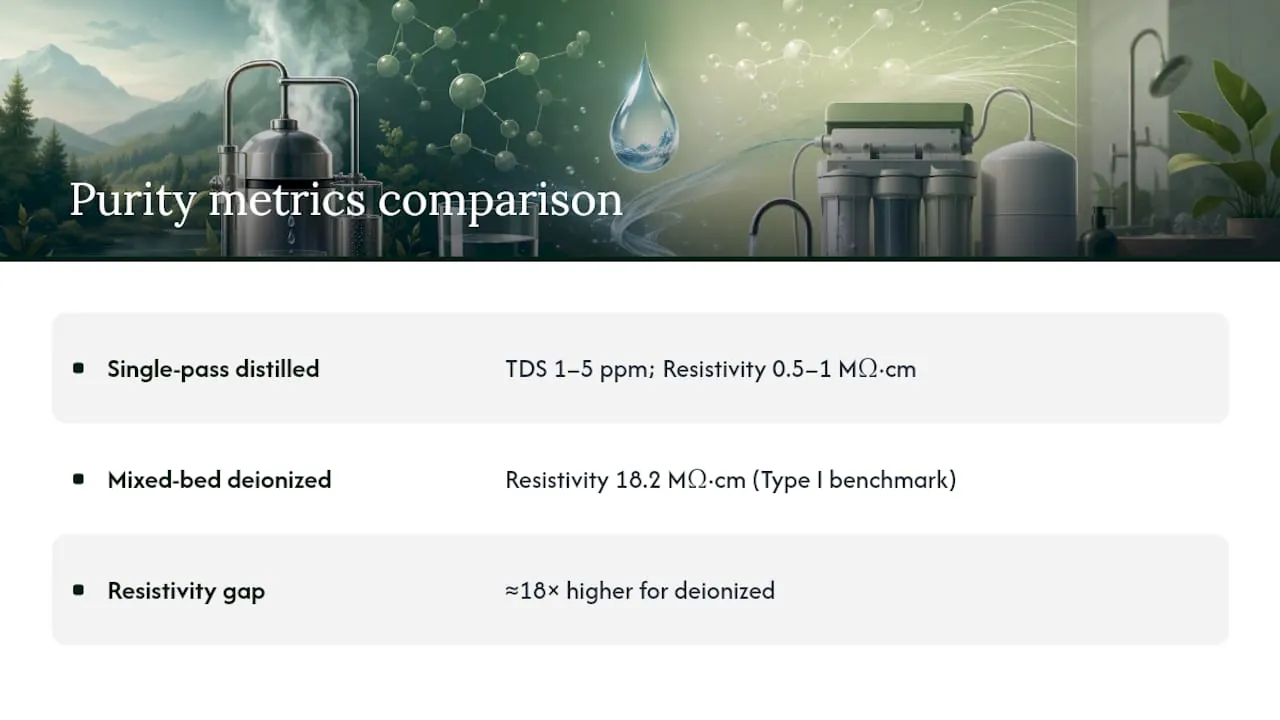
That 18x gap in resistivity is why a lab protocol calling for Type I water will reject distilled water outright, even though both look identical in a glass. The physical reference data NIST maintains for pure water underlines just how sensitive these measurements are to even trace contamination.
What each method misses, and where that gap matters
Neither process is a universal filter, and the blind spots run in opposite directions.
- Distillation removes dissolved solids, most microbes, and particulates, but volatile organic compounds can evaporate along with the water and recondense right back into your distillate unless the system uses a carbon trap or additional filtration stage.
- Deionization strips out ions, salts, heavy metals, minerals, but it has no effect on uncharged organics, bacteria, or viruses. DI water is not inherently sterile unless it’s paired with disinfection or fine filtration.
This split explains why different industries pick different water. Pharmaceutical labs running chromatography care about organic and VOC contamination, so distillation with proper trapping (or DI paired with carbon filtration) matters more. Electronics manufacturers rinsing circuit boards care about ionic residue causing corrosion or short circuits, so DI wins there regardless of microbial content.
Pro Tip: If your process needs both ionic purity and microbial control, don’t assume one method covers both. Pair DI with a 0.2-micron filter or UV stage, or pair distillation with a carbon polishing step, depending on which gap actually threatens your result.
Common uses and which water actually belongs there
Matching the water to the task protects your equipment and your results. Here’s how that breaks down in practice:
- Lab analytics and HPLC work typically need DI water, sometimes combined with reverse osmosis, to hit Type I ionic purity. Some instruments specify this explicitly in their manuals.
- CPAP machines, humidifiers, steam irons, and autoclaves do better with distilled water. Minerals in tap or even DI water can leave scale deposits inside heating elements over time, and distillation’s microbial removal is a genuine advantage in devices you breathe through.
- Electronics rinsing and PCB manufacturing call for DI water because even trace minerals left behind can create conductive paths where none should exist.
- Batteries and closed coolant loops rely on DI water to prevent scaling and internal corrosion, since mineral buildup degrades both performance and lifespan.
- General cleaning, final equipment rinses, and other non-critical tasks work fine with either type. This is where cost and convenience should drive the decision, not chemistry.
Is it safe to drink? Distilled and deionized water compared
Distilled water is generally safe to drink short term. It lacks the minerals found in tap or spring water, which is why some people describe the taste as flat, and how you store it matters: a container that’s been sitting open invites contamination that undoes the purification.
Deionized water is a different story:
- DI water isn’t recommended for regular drinking because the process doesn’t guarantee removal of bacteria, viruses, or organic contaminants.
- Ion-free water can be more aggressive at leaching trace minerals from piping or containers it sits in.
- Untreated DI water straight from a lab or industrial system should never be treated as a drinking water source.
- If you want reliably safe drinking water, municipally treated tap water or certified bottled water is the better default, with distilled water as a reasonable option for people managing sodium intake or other specific dietary concerns.
Can you substitute one for the other? A quick checklist
Before you swap distilled for deionized water, or the reverse, run through this:
- Check the spec sheet. Devices and lab protocols often name an exact water grade; using the wrong one can void a warranty or invalidate test results entirely.
- Identify what the application actually needs. Ionic purity points to DI. Microbial or organic control points to distillation, or a combination of both.
- Think about volume. DI systems scale well for continuous, high-throughput needs, though resin replacement is an ongoing cost. Distillation is batch-based and energy-intensive, which makes it less practical at industrial scale but perfectly fine for household use.
Can you make distilled water at home?
Yes, with a basic setup. A stovetop method or a countertop distiller kit both work on the same principle: boil water, capture the steam, cool it back to liquid.
- Fill a pot with tap water and place a smaller heat-safe bowl in the centre, floating or elevated.
- Boil with the lid inverted so condensation drips into the bowl instead of back into the pot.
- Collect the condensed water once cooled.
- Store it in a sanitized, sealed glass container to avoid recontamination.
Home methods commonly miss VOC removal since there’s no carbon trap stage, and yield is low, often under a litre per hour. That trade-off is fine for occasional need, less so if you’re refilling a CPAP machine nightly.
Our take: skip the DIY math if convenience matters more
For appliances, humidifiers, and occasional drinking, buy distilled water rather than fuss with a home still. Save deionized water for ion-sensitive technical work, and only when it’s properly treated for your use case. If you’re not chasing a lab-grade spec, a scheduled delivery service beats stovetop batches every time.
— Yan
Get distilled water delivered instead of making it yourself
This service is an alternative to stovetop distillation and store runs for households and businesses, offering consistent bottles on your schedule. Distilled water is delivered in 18L and 11L bottles, with options for one-time, weekly, biweekly, or monthly delivery.

Delivery makes the most sense once you’re using distilled water regularly, such as for CPAP machines, steam irons, health clinic equipment, or households wanting consistent supply. There is no long-term contract, prices are clearly stated without hidden fees, and bottle deposits are refundable. If you’d rather spend your time on anything other than monitoring a pot of boiling water, order distilled water delivery and set your own cadence.
Sources
Technical figures in this article draw from NIST’s chemistry reference data, the PubChem entry for water, and industry comparisons from ThoughtCo, Crystal Quest, and WaterDefense.
- Distilled versus deionized water (ThoughtCo)
- Distilled vs Deionized Water: Key Differences (Crystal Quest)
- Distilled vs Deionized Water - Differences and Comparison (WaterDefense)
FAQ
Can I use distilled water instead of deionized water?
Only if your application doesn’t require ion-free purity. Distilled water works for appliances and general use, but it won’t hit the resistivity levels many lab protocols demand.
Can you drink deionized and distilled water?
Distilled water is generally safe to drink short term, though it lacks minerals. Deionized water isn’t recommended as a drinking source since the process doesn’t guarantee pathogens are removed.
Can I make distilled water at home?
Yes, using a stovetop setup or a countertop distiller kit, though yield is low and volatile organic compounds may carry over without a carbon trap stage.
Is deionized water the same as distilled water?
No. Distillation uses heat to separate water from contaminants, while deionization uses ion exchange resin to strip out charged particles, and each method misses different things.