
Homeowners: When Distilled Water Is Worth Buying for Spot Free Windows
Yes, distilled water reduces mineral spotting and works well for interior panes, mirrors, and final rinses on small jobs. It won’t fully replace a professional DI/RO system on large exterior work, and you should still expect some buffing with a microfiber towel. Use it right, and you’ll get noticeably cleaner, streak-free glass with only a modest amount of extra effort.
TL;DR:
- Distilled water is practical for small-scale interior or single-story exterior cleaning but becomes inefficient for large-scale jobs where a professional DI or RO system is more cost-effective.
- Tap water’s mineral content, often above 100 ppm, causes white spots after evaporation, making distilled water almost essential for streak-free results.
- Proper cleaning workflow—including separate rinse and clean buckets, immediate buffing, and using sealed water supplies—plays a critical role in avoiding streaks, even with distilled water.
- Bottled distilled water is suitable for occasional use, but continuous professional systems offer better scalability and reduced manual labor for bigger projects.
- Secured, scheduled delivery of sealed distilled water simplifies maintenance and ensures consistent quality, which is especially valuable for frequent or commercial cleaning.
CapitalflowKeep Distilled Water On HandPurity in Motion delivers consistent distilled water to Ottawa homes and businesses on a flexible weekly, biweekly, or monthly schedule.Visit Purity in Motion
Table of Contents
- What is distilled water and how does it compare to deionised or RO water?
- Why does tap water leave spots on windows?
- When does distilled water make sense, and when doesn’t it?
- How to clean windows with distilled water step by step
- Bottled distilled water vs. professional DI/RO systems: the trade-offs
- Why sealed delivery makes DIY distilled-water cleaning easier
- Why the “just use distilled water” advice oversimplifies things
- Ready for spot-free windows without the hassle?
- Sources
- FAQ
What is distilled water and how does it compare to deionised or RO water?
Distillation, deionisation, and reverse osmosis all strip minerals from water, but they work differently. Distillation boils water and collects the steam, leaving calcium, magnesium, and other solids behind in the original container. Deionisation pulls charged mineral ions out using resin beads. Reverse osmosis forces water through a membrane fine enough to block dissolved minerals while letting water molecules through.
Tap water typically carries 50 to 300+ parts per million (ppm) of dissolved solids, depending on your municipal supply and local water hardness. Distilled water and properly maintained DI or RO systems both land close to 0 ppm.
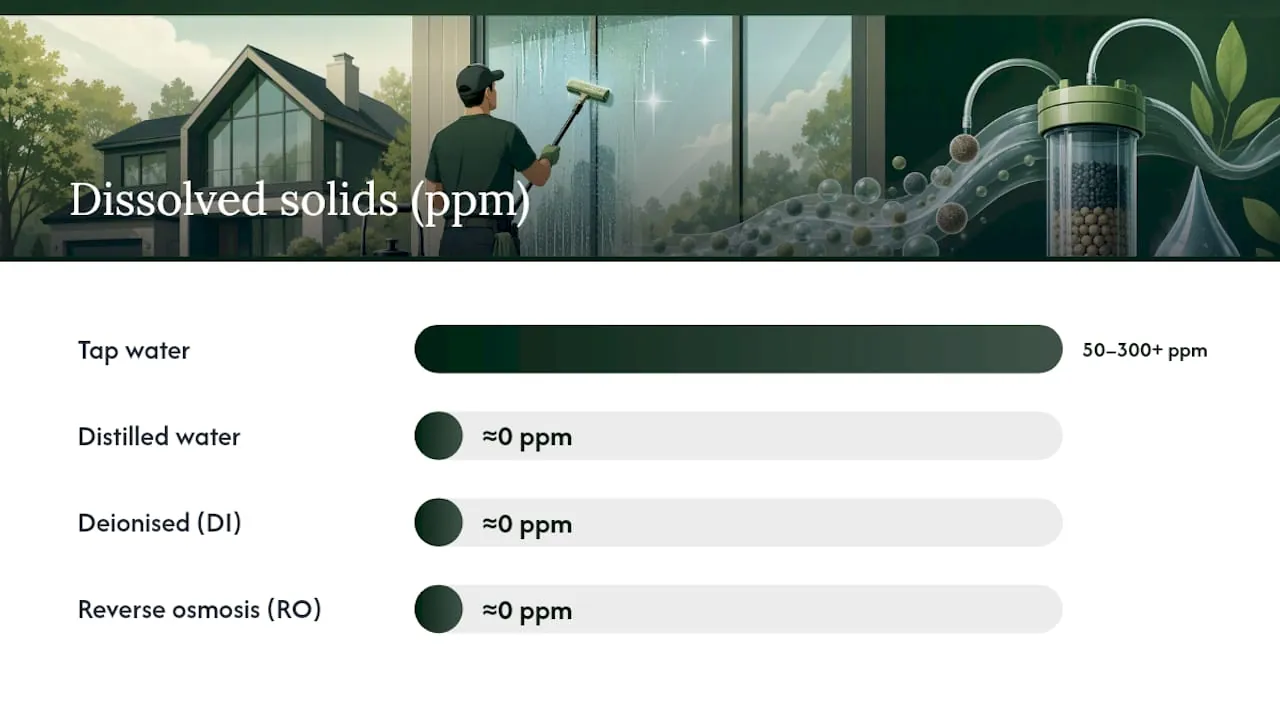
That gap explains why professionals lean on DI/RO flow-through systems instead of hauling jugs of distilled water. These systems produce continuous, near-zero-mineral water on demand, which matters a lot once you’re rinsing an entire building rather than a bathroom mirror. Reverse osmosis, in particular, is a common backbone of multi-stage professional purification setups.
Why does tap water leave spots on windows?
Water spots aren’t dirt. They’re mineral leftovers. When tap water evaporates off glass, the calcium and magnesium it carried stay behind as a chalky white film. The water disappears; the minerals don’t.
Higher TDS means more minerals waiting to be deposited, so even water that looks perfectly clear can leave a visible ring once it dries. This is why a spot-free rinse matters more than a clean-looking bucket. If your tap water tests above roughly 100 to 150 ppm, expect spotting on dark-tinted glass or black window frames almost every time you use it for a final rinse.
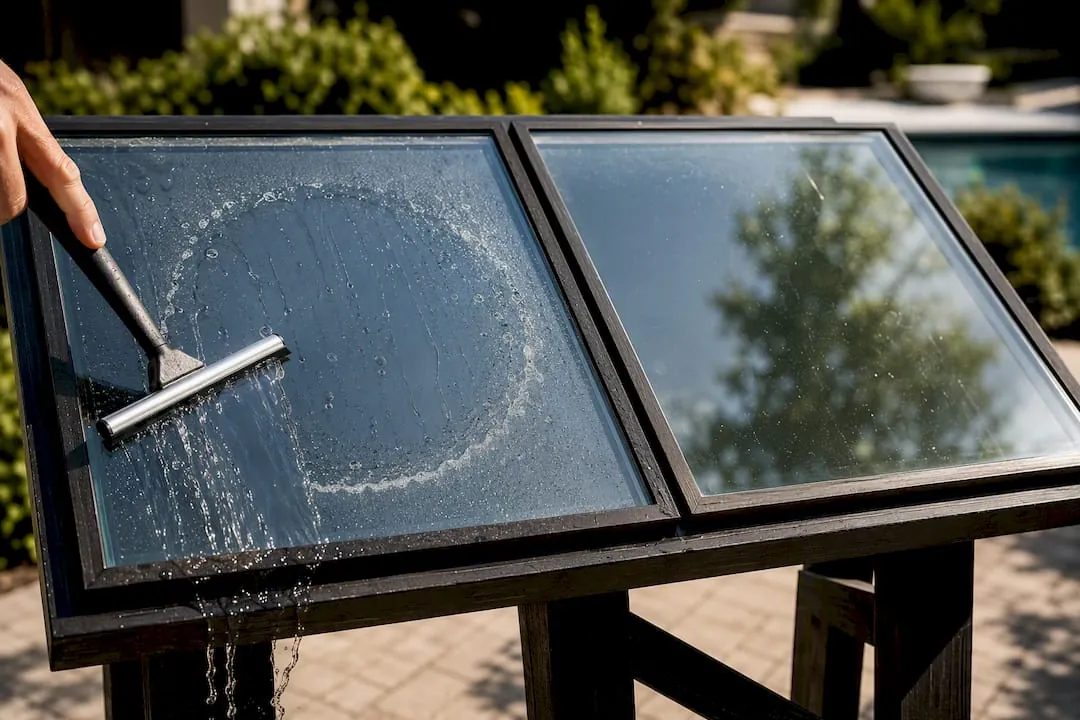
Distilled water sidesteps the problem because there’s essentially nothing left to deposit. A quick way to picture it: rinse one pane with tap water and an identical pane with distilled water, let both air-dry in the sun, and you’ll see the difference in under ten minutes.
When does distilled water make sense, and when doesn’t it?
Distilled water earns its keep on smaller, controlled jobs. Interior panes, bathroom and vehicle mirrors, glass shower doors, and car-detailing touch-ups are all excellent candidates. It’s also a smart choice for the final rinse pass on a small exterior job, like a single-storey home with six or eight windows.
Where it starts to strain is scale. Multi-storey buildings, large storefronts, or any job with dozens of windows demand more purified water than a few jugs can practically supply. That’s the point where a professional with a DI/RO system becomes the more sensible option.
Before you decide, run through a short checklist:
- Window size and count: a handful of panes favours distilled water; dozens favour a pro system.
- Soil level: heavy grime needs a cleaning solution first, with distilled water reserved for the rinse.
- Frequency: monthly touch-ups are easy with jugs; weekly full-house cleaning gets expensive fast.
- Water access: no outdoor tap or hose bib nearby often makes bottled distilled water the only practical option anyway.
- Tolerance for buffing: distilled water still needs a squeegee or towel pass to look its best.
How to clean windows with distilled water step by step
Getting a streak-free finish isn’t complicated, but a few small habits separate a good result from a frustrating one.
Tools to gather:
- A sealed spray bottle (rinsed clean, never reused from a chemical container)
- Two dedicated microfiber towels, one damp and one dry
- A squeegee with a fresh rubber blade
- A soft scrubber or sponge
- Two buckets: one for cleaning solution, one for distilled rinse water
The workflow:
- Wipe down frames, sills, and edges first. Loose dust here is the number one cause of “clean” water turning gritty mid-job.
- Apply a mild cleaning solution to cut through grease or grime, using the scrubber from your first bucket.
- Rinse thoroughly with distilled water from your second bucket or spray bottle, keeping that water completely separate from your cleaning solution.
- Squeegee or buff immediately while the rinse water is still fresh on the glass. Waiting lets even distilled water start evaporating unevenly.
- Detail the edges and corners with a dry microfiber towel to catch any pooling.
Skip these common mistakes: dipping a dirty scrubber into your rinse bucket, working in direct sunlight (which flash-dries water before you can buff it), and topping up your distilled water with tap water “just to stretch it further.” That last habit alone defeats the entire purpose.
Pro Tip: Pick up an inexpensive TDS meter and test your water before you start. If it reads near 0 ppm, you’re good to go. If it’s climbing toward 50 or higher, something’s contaminating your supply, and it’s worth running a spot test on one pane before you commit to the whole job.
Bottled distilled water vs. professional DI/RO systems: the trade-offs
Buying jugs of distilled water has real advantages for smaller jobs. The upfront cost is low, it’s available at almost any grocery or hardware store, and sealed containers keep contamination risk near zero until you open them.
The limitations show up at volume. A single jug only goes so far, opened containers can pick up contaminants if left sitting around, and you’ll do more manual buffing per window than you would with a continuous-flow system. Cost per litre also climbs quickly once you’re buying in bulk for anything larger than a modest home.
Professional DI/RO systems solve the volume problem outright: they output water near 0 ppm continuously, which cuts down on finishing labour and scales easily to whole-building exteriors. For a homeowner doing a seasonal deep clean or a small business with a few storefront windows, investing in a countertop DI unit or hiring a professional crew starts to pencil out once the labour savings on buffing and re-wiping outweigh the equipment cost.
Why sealed delivery makes DIY distilled-water cleaning easier
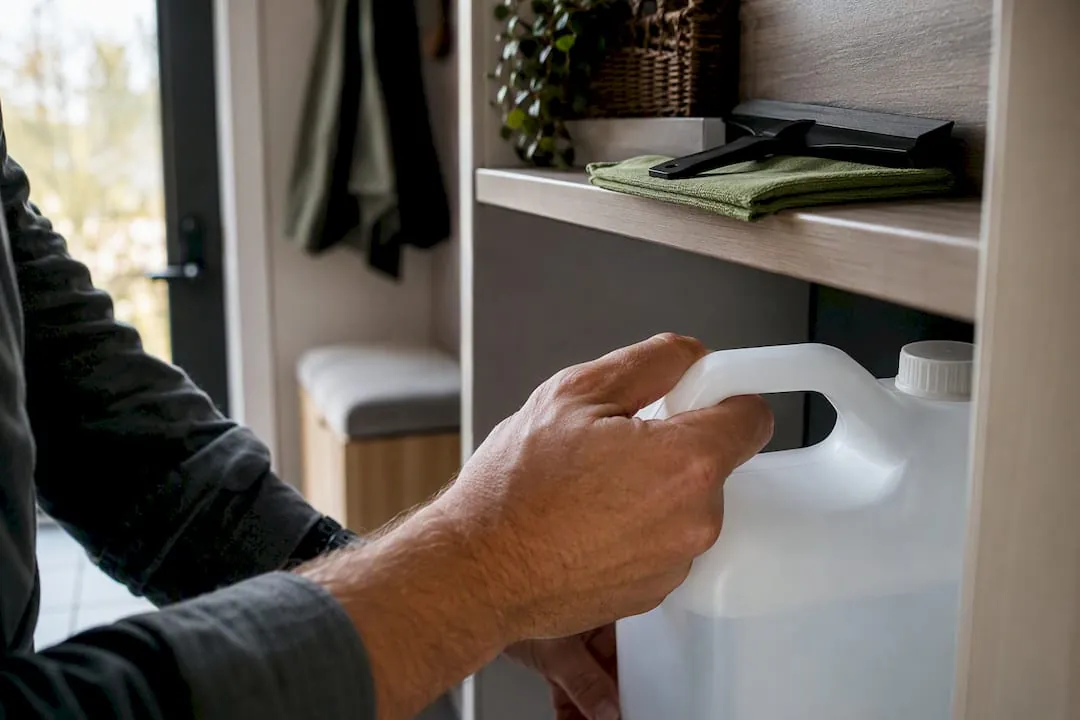
Contamination is the quiet enemy of a spot-free finish. Even 0 ppm water picks up dust and residue fast once a jug sits open on a shelf for a few weeks, which is exactly why sealed containers and a dependable supply matter more than most guides admit.
A local service can deliver distilled water in sealed 11L and 18L jugs with scheduling options such as weekly, biweekly, or monthly to fit your routine. That kind of consistency means fresh, sealed water is on hand exactly when you’re ready to clean, rather than a half-used jug that’s been sitting in the garage since spring. Homes running regular window and mirror maintenance, and small businesses keeping storefront glass looking sharp, both benefit from not having to think about sourcing water at all.
Why the “just use distilled water” advice oversimplifies things
Most guides treat distilled water as a silver bullet. It isn’t. The research is clear that mineral removal solves spotting, but plenty of DIY cleaners still end up with streaky windows because they contaminate the water somewhere between the jug and the glass, whether that’s a dirty scrubber, a splash of tap water “to save the jug,” or forgetting to buff before the rinse evaporates.
The conventional advice skips the process discipline entirely. It tells you what water to buy and stops there, when the bigger lesson from professional window cleaning is that purity has to survive the entire workflow, not just the pour.
If you’re a homeowner weighing this, prioritize consistency over cleverness. A sealed, tested water supply used with a simple two-bucket method will outperform an expensive gadget used carelessly. And if your job is bigger than a few panes, don’t force distilled water to do a professional system’s work. Match the tool to the scale, and the streaks take care of themselves.
— Yan
Ready for spot-free windows without the hassle?
If you’ve read this far, you already know the real challenge isn’t finding distilled water once. It’s keeping a fresh, sealed supply on hand every time you’re ready to clean, without a half-open jug sitting around picking up dust. Some services offer reliable distilled water delivery with sealed containers to ensure freshness and convenience.

Here’s what you get:
- Sealed bottles, helping keep your water contaminant-free until used
- Flexible delivery scheduling options
- Clear pricing with no hidden fees and bottle deposits that may be refundable
Whether you’re maintaining a house full of windows or keeping a storefront spotless, a reliable distilled water delivery means one less thing to plan around. Visit the Capitalflow landing page to check delivery options in your area and get your first order scheduled.
Sources
- Cleaning with distilled water for spot-free windows — Professional Window Cleaning
- Using distilled water to wash exterior windows and avoid hard water spots — Philip Greenspun’s Weblog
- Spot-free rinse applications — ResinTech
- Reverse osmosis — Wikipedia
FAQ
What do professional window cleaners use in their water?
Most professionals use DI, RO, or combined pure-water systems that continuously output water near 0 ppm, rather than bottled distilled water, because it scales better across large exterior jobs.
Can I turn my tap water into distilled water at home?
Not through simple filtration. True distillation requires boiling water and collecting the steam, which most households don’t do; a countertop DI or RO unit is a more practical way to get comparably pure water at home.
What kind of water is best for cleaning windows?
Distilled, deionised, or reverse-osmosis water all work well because each removes the calcium and magnesium responsible for water spots, with distilled water being the most accessible option for small DIY jobs.
How do I make pure water for window cleaning without buying it?
A home DI or RO filtration unit is the closest DIY substitute, though for occasional use, sealed distilled water delivered on a schedule is usually simpler and avoids equipment upkeep entirely.
Is distilled water safe to use on all window types?
Yes, distilled water is safe on standard glass, tinted glass, and most window frames, since it contains no additives or minerals that could react with sealants or coatings.